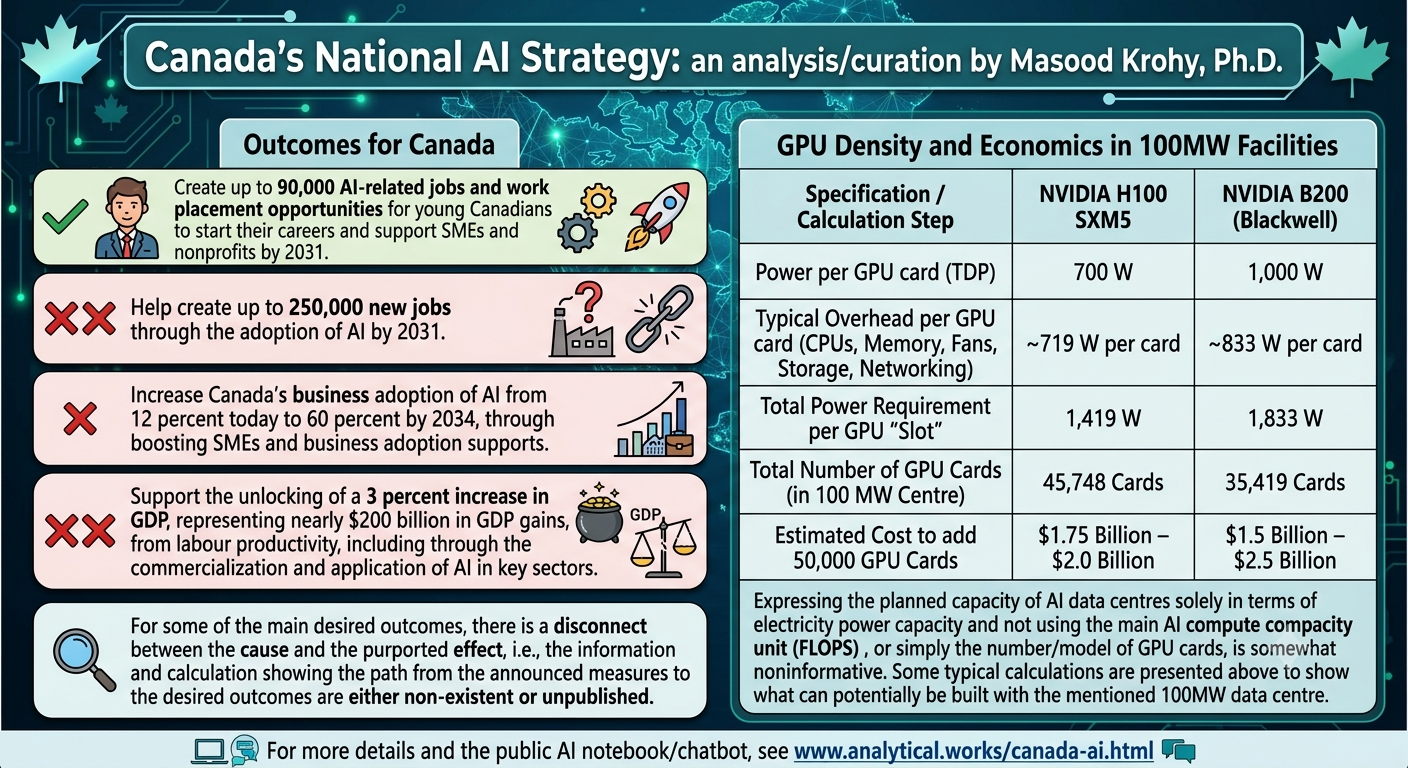
Canada’s National AI Strategy was in the works for several months and was unveiled several days ago. The focus and ambitions (Outcomes for Canada) are good. Some key details are missing in the report, though; hence this post. I carefully read the 50-page report, then put it in an AI system along with several other industry articles and reports (data centre build announcements and surveys, GPU costs, etc.) and validated my conclusions. I hope the next version of this National AI Strategy fills in the information gaps and/or amends the numbers if need be.
An AI notebook/chatbot with Google’s NotebookLM (needs a Google account to access and use)
Outcomes for Canada
For some of the main desired outcomes, there is a disconnect between the cause and the purported effect, i.e., the information and calculation showing the path from the announced measures to the desired outcomes are either non-existent or unpublished.
- Outcome #1: Create up to 90,000 AI-related jobs and work placement opportunities for young Canadians to start their careers and support SMEs and nonprofits by 2031.
- Details have been provided: Canada will create up to 90,000 AI-related job opportunities, including 45,000 through the Student Work Placement Program and Canada Summer Jobs, and 35,000 through other initiatives such as the Skills for Success Program, and 10,000 through the Mitacs ADOPT and AI+X programs.
- Outcome #2: Help create up to 250,000 new jobs through the adoption of AI by 2031.
- No details leading to that specific number have been provided.
- Outcome #3: Increase Canada’s business adoption of AI from 12 percent today to 60 percent by 2034, through boosting SMEs and business adoption supports.
- No details leading to that specific number have been provided, however, there are some measures/statements pushing in that direction:
- The ambition is concrete: by 2034, 60 percent of Canadian businesses, particularly SMEs, will have adopted AI tools.
- Canada will utilize the LIFT program, a $500 million initiative from the Business Development Bank of Canada (BDC) to help Canadian SMEs access financing to incorporate AI tools in their operations.
- Canada will invest $500 million to expand and enhance the Regional Artificial Intelligence Initiative delivered through Regional Development Agencies to accelerate adoption and commercialization of AI across the country.
- Canada will support the development of an AI Literacy and Adoption Assessment tool and other online resources that help SMEs and entrepreneurs assess their AI readiness, identify practical use cases, understand potential business impacts in a low-risk environment, and connect with critical programs and development agencies.
- Canada will provide targeted support to strengthen AI adoption among Canadian entrepreneurs through the Small Business and Entrepreneurship Development Program.
- Canada will leverage the SR&ED tax credit and the Productivity Super-Deduction announced in Budget 2025 to catalyze private sector investment and make innovation more affordable.
- No details leading to that specific number have been provided, however, there are some measures/statements pushing in that direction:
- Outcome #4: Support the unlocking of a 3 percent increase in GDP, representing nearly $200 billion in GDP gains, from labour productivity, including through the commercialization and application of AI in key sectors.
- No details leading to that specific number have been provided.
Sovereign AI compute
The Canadian government seems to favour the path of partnerships with some data centre builders to improve the situation regarding the sovereign AI compute in Canada. The report contains some potential data centres capacity of which are solely expressed in megawatts. Expressing the planned capacity of AI data centres solely in terms of electricity power capacity and not using the main AI compute compacity unit (FLOPS), or simply the number/model of GPU cards, is somewhat noninformative. Some typical calculations are presented in the infographics accompanying this post to show what can potentially be built with the mentioned 100MW data centre. The report also suggests data centre proposals with capacity up to 850MW, scalable to 2.3GW, are being considered.